


Efficient fans could cut Bangladesh’s summer power demand by up to 2,590MW: IEEFA
Switching household ceiling fans to energy-efficient BLDC models could cut Bangladesh's summer peak power demand by up to 2,590MW, a new IEEFA study says. Upfront cost remains the main barrier.
Replacing ordinary household ceiling fans with energy-efficient BLDC (brushless direct current) fans could cut Bangladesh’s summer peak power demand by up to 2,590 megawatts, according to a new study by the US-based Institute for Energy Economics and Financial Analysis (IEEFA). The study was released on 2 November.
Fans take a large share of power
The report, titled “Household space cooling in Bangladesh: Role of energy-efficient fans”, was written by Shafiqul Alam, IEEFA’s Lead Energy Analyst for Bangladesh. It is based on a survey of 435 households across 26 districts, grouped by monthly income.
The study finds that household fans alone draw between 3,362MW and 5,212MW in summer, with demand peaking around 9PM. IEEFA notes that on 27 August this year the country’s power demand reached 19,027MW at 9PM.
A conventional fan runs at 70W or more, while a BLDC fan uses 35W. Yet only 1.4% of the fans in use among surveyed households are BLDC models.
How much could be saved
The report says that if all households switched to BLDC fans, summer power demand could fall by between 1,670MW and 2,590MW, though it notes that a complete nationwide shift will take time.
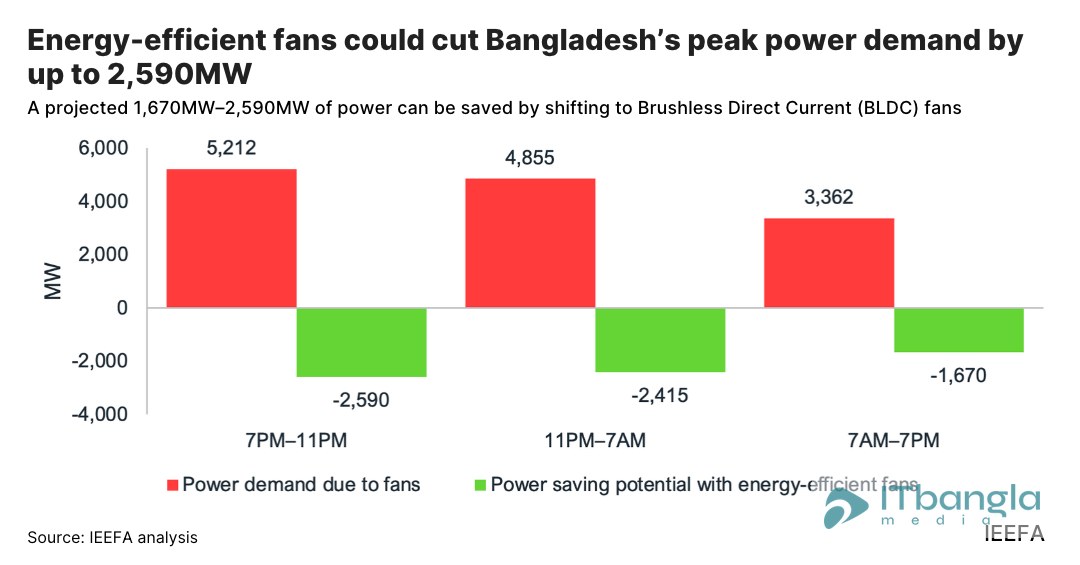
It estimates annual savings of 6,913 gigawatt-hours of electricity, worth around BDT 89.87 billion. Lower demand could also help avoid more than USD 4 billion of future investment in coal-fired power plants. According to IEEFA, that amount would be enough to replace all the inefficient fans currently in use in the country.
Price is the main barrier
After learning about the savings, 96% of surveyed households said they were willing to switch to BLDC fans. The main obstacle is the upfront cost: an ordinary fan costs around BDT 2,000, while a BLDC fan costs between BDT 5,000 and BDT 6,300.
For households earning up to BDT 25,000 a month, the study says the extra cost could take 7.7 to 9.6 years to pay back. Bulk procurement combined with carbon revenue could bring this down to 4.8 years.
Recommendations
- Design a national programme for energy-efficient household fans and set up a “super ESCO” (energy service company) to implement it
- Raise public awareness of energy-efficient fans
- Have the Sustainable and Renewable Energy Development Authority (SREDA) finalise standards and labelling for fans
- Adopt a cost-reduction strategy for low-income households, such as bulk purchasing and the use of carbon revenue
- Create financing options, such as instalments paid through electricity bills
- IEEFA: press release and full report, 2 November 2026
- The Business Standard Facebook post, 2 November 2026, 1:10 PM — view the original post

Comments