
Adviser says Bangladesh aims to build AI infrastructure in 12 months, not a ChatGPT-style model
Speaking at the Grameenphone FutureMakers 2026 grand finale, adviser Rehan Asif Asad said the government’s aim is not to build its own language model, but to put the country’s first AI infrastructure and data center in place within 12 months.
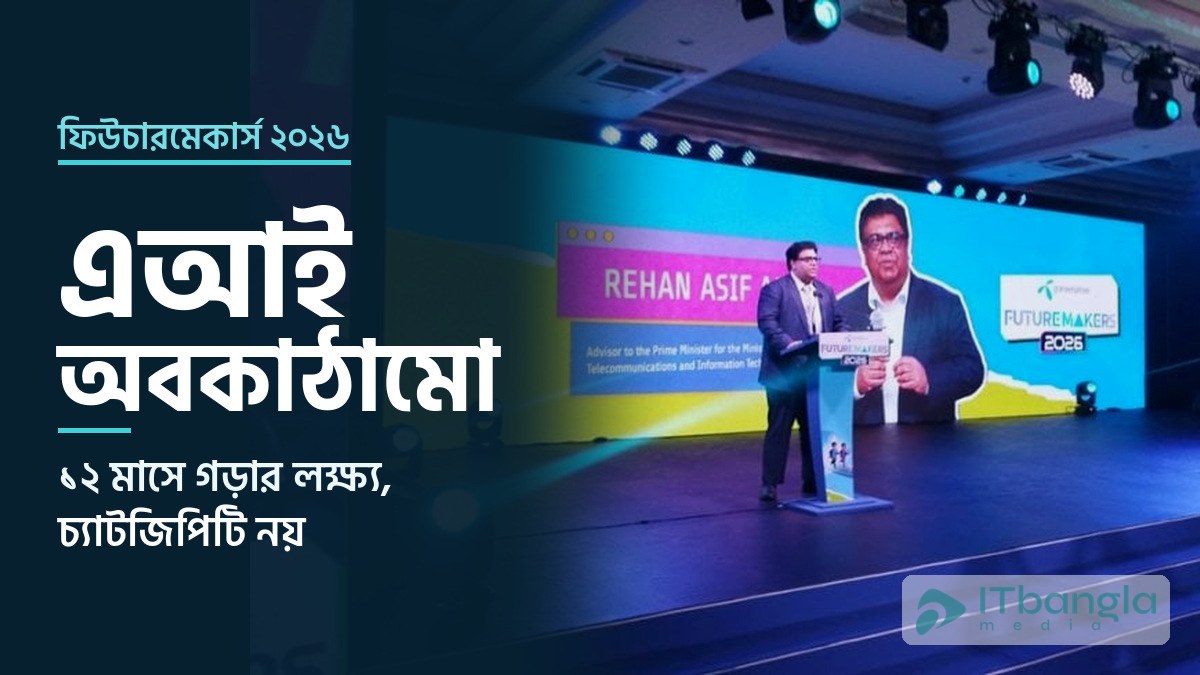
The government is working to build the country’s first artificial intelligence (AI) infrastructure and data center within the next 12 months, but its aim is not to create a language model of its own along the lines of ChatGPT. The goal is instead to provide computing capacity and access to necessary data for Bangladeshi students, researchers, entrepreneurs and technology firms, DigiBanglaTech reported at 8:44 p.m. on 10 November 2026 (Asia/Dhaka), quoting Rehan Asif Asad, the Prime Minister’s adviser for the Ministry of Posts, Telecommunications and Information Technology. The report was updated at 11:45 p.m. the same day.
The adviser was speaking on Tuesday, 10 November, at the grand finale of the second edition of Grameenphone’s AI idea competition FutureMakers 2026, held at a hotel in the capital under the theme “AI for Social Good.” He said Bangladesh had not been able to take full advantage of the software revolution of the 1990s, but the government does not want to miss the AI revolution. The priority now, he said, is to develop young people not only as users of AI but as innovators capable of solving real problems.
According to DigiBanglaTech, more than 7,000 students from over 70 universities took part this year and submitted 1,130 AI-based ideas. Bangladesh Sangbad Sangstha (BSS), in a report at 9:59 p.m. the same day citing a Grameenphone press release, put the number of ideas at 1,103. Both reports said student participation was about 40 percent higher than in the first edition in 2025. Students from STEM and other disciplines presented ideas in seven areas, including digital inclusion and education, healthcare and mental wellbeing, skills and employment, gender equality, and environmental protection.
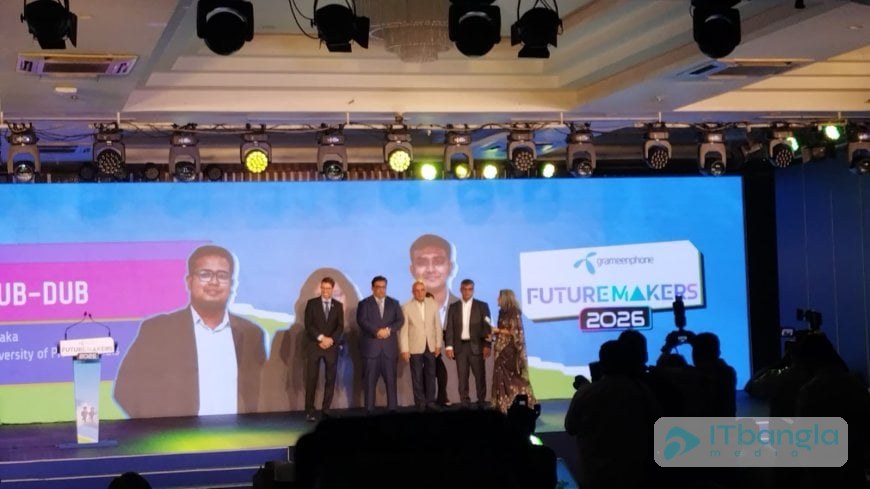
Team LubDub was named champion of FutureMakers 2026 for EchoClip, an AI-powered clip-on device that attaches to a conventional stethoscope and can help detect possible early signs of heart disease. First runner-up was Team River Sentinel, whose AI-based river-erosion forecasting system is designed to identify vulnerable areas and issue early warnings. Second runner-up was Team Jinxed, for Spasto AI, an AI-supported speech-therapy application that offers personalized treatment plans, guided home practice and progress tracking.
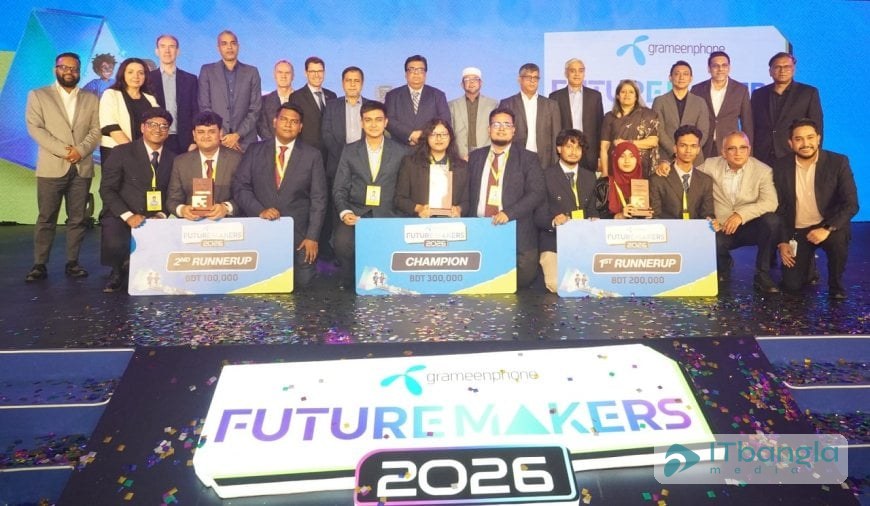
The champion team received Tk 3 lakh, the first runner-up Tk 2 lakh and the second runner-up Tk 1 lakh. Members of the winning teams will also get a direct route into Grameenphone’s Next Business Leader (NBL) and Nextern internship programs, the report said. Ideas were judged on innovation, feasibility, potential social impact and effective use of AI. The judging panel included BTRC commissioner for engineering and operations Brigadier General Iqbal Ahmed (retd) and Grameenphone chief executive officer Yasir Azman, along with other senior officials of the company.
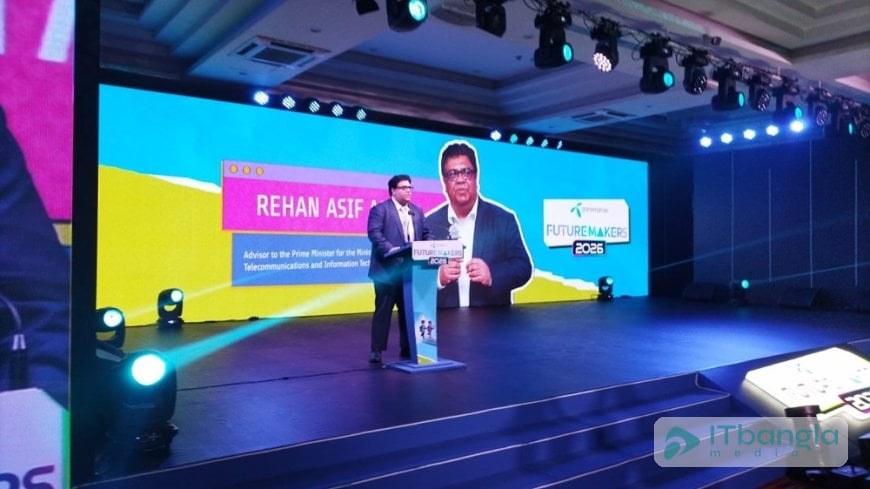
In his keynote remarks, Asad urged journalists not to treat AI infrastructure and AI models as the same thing. The four large AI companies were spending about 750 to 800 billion dollars on building language models, he said, and Bangladesh did not intend to build that kind of costly model. The government’s plan, he said, is to develop GPU capacity, high-speed memory, advanced NPUs and inference capability, and to open that infrastructure to students, researchers, the private sector and government agencies so that new innovators do not have to spend heavily to use GPUs. He said preparations were under way, with international partners, to launch the country’s first AI infrastructure and data center within 12 months, and that the implementation method and partners would be announced soon.
Asad also said the government was placing emphasis on five layers of technological progress: laws, policies and guidelines; secure and robust connectivity; digital public infrastructure under a “one citizen, one ID, one wallet” idea; AI and cybersecurity; and the manufacture of consumer electronics, semiconductors and equipment. On digital public infrastructure, he said Bangladesh still lacks strong e-governance and a complete framework; a team of experts from Estonia is assisting the government, and he had met them that morning. He referred to the open-source X-Road model developed by Estonia and MIT. On electronics manufacturing, he claimed that significant changes had followed the latest budget and that almost all high-end Android phones except Apple were now being produced in Bangladesh.
BTRC chairman Major General Md Emdad Ul Bari (retd) attended as special guest and praised the young people’s digital and responsible innovation. Also present were Norway’s ambassador to Bangladesh, Håkon Arald Gulbrandsen, Grameenphone CEO Yasir Azman and other senior officials of the company.
At the same event the adviser also said the government had invited Apple and held preliminary talks, which ITBangla has reported separately.
Sources
- DigiBanglaTech, “১২ মাসে এআই অবকাঠামো গড়বে বাংলাদেশ, চ্যাটজিপিটি তৈরির লক্ষ্য নয়”, 10 November 2026, 8:44 p.m., updated 11:45 p.m. (Asia/Dhaka), https://digibanglatech.news/195325
- Bangladesh Sangbad Sangstha (BSS), “Youth must be equipped to take part in AI transformation: Rehan Asif”, 10 November 2026, 9:59 p.m. (Asia/Dhaka), citing a Grameenphone press release, https://www.bssnews.net/others/444325