
The ‘Ella’ reel going viral: the risks of posting your child’s photos online, and what parents can do
A reel being shared on Facebook is in fact Deutsche Telekom’s 2023 deepfake campaign. An explainer on AI-made fake images, identity theft and location exposure, and what parents can do.

Staff Correspondent
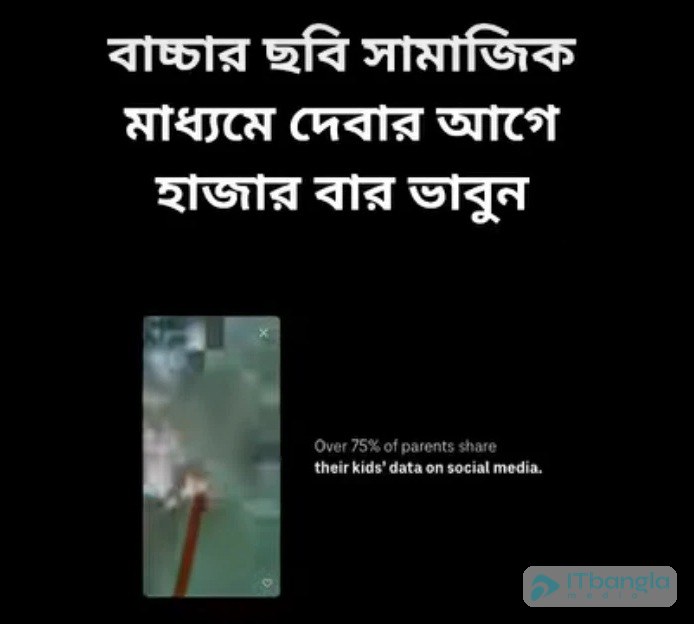
A reel about children’s photos is being shared on Facebook. Posted by a page called “Desh Bidesher Biggapon”, it carries a Bangla overlay that reads, “Think a thousand times before posting your child’s photo on social media.” The reel has no caption. By Sunday night it had 191 reactions and 34 shares.
The video itself is not new. Its English text and visuals match “A Message from Ella”, a 2023 campaign by the German telecom company Deutsche Telekom. No company name or logo appears in the reel. But its line “Over 75% of parents share their kids’ data on social media” is word for word the same as in the campaign description, and the scene of that line beside a pixelated photo matches the campaign’s award entry.
What the campaign showed
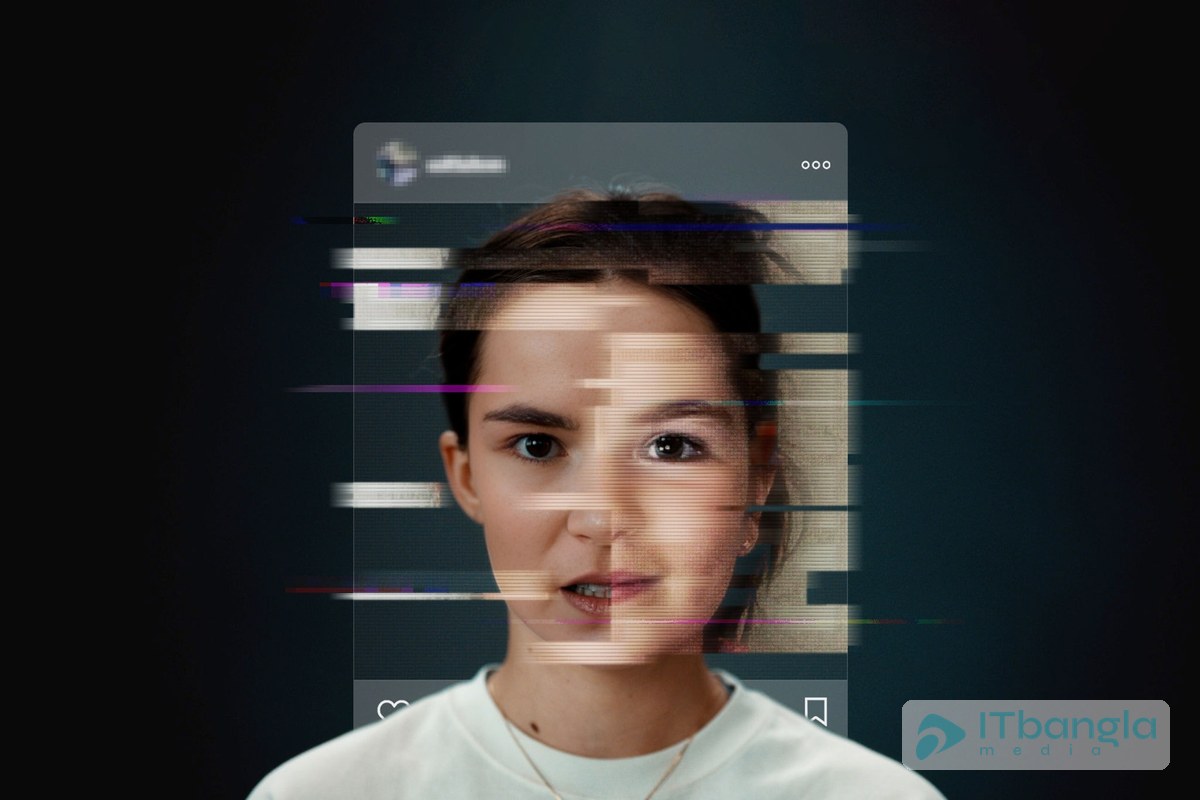
Deutsche Telekom launched the #ShareWithCare campaign on 3 July 2023. According to the company, AI was used on a photo of a nine-year-old actress to create a deepfake of her as an adult. In the film, this fictional “grown-up Ella” confronts her parents and, like a message from the future, tells them how the photos they shared of her as a child could harm her.
The company said the film dramatises a social experiment, but that the technology behind it is already widely available. In Deutsche Telekom’s words, carelessly sharing children’s images can expose them to profiling by data brokers, hacking, facial recognition, paedophiles and other privacy and safety threats.
According to the campaign entry submitted to The One Club, the film reached 71 countries and was viewed more than 51 million times. Those figures come from the campaign’s makers.
What “sharenting” is, and how common it is
“Sharenting”, a blend of sharing and parenting, describes parents posting photos, videos and everyday details of their children on social media.
A 2016 survey of 2,000 parents, carried out by The Parent Zone for the UK domain registry Nominet, found that the average parent had posted 1,498 photos of their child online by the child’s fifth birthday. Deutsche Telekom’s campaign also cites an average of 1,500 photos by age five.
Another survey of 795 parents in Germany, conducted for Deutsche Telekom in July and August 2023, found that 86 percent share photos or videos of their children online. According to the company, only a third knew that a single photo can be enough for identity theft, and 65 percent did not know what had happened to the photos they had sent.
Risk 1: AI-made fake images and videos
The biggest concern now is generative AI. Even an ordinary, fully clothed photo can be turned into an abusive fake. The UK-based Internet Watch Foundation (IWF), which finds and removes child sexual abuse content, published its 2025 data in January this year.
The IWF said it identified 8,029 realistic AI-generated images and videos of child sexual abuse in 2025. Of these, 3,443 were videos, compared with just 13 such videos in 2024. The organisation says this material often draws on real children’s faces or images, and some of it has been used for blackmail and sexual extortion.
The CyberTipline of the US National Center for Missing & Exploited Children (NCMEC) shows a similar trend. It received 4,700 reports involving generative AI in 2023 and 67,000 in 2024. In 2025, such reports exceeded 400,000.
On 3 July this year, the UK’s National Crime Agency (NCA) and the IWF issued joint guidance for parents. According to The Guardian, it advises against keeping children’s photos on public display. The report also said some UK school websites had been targeted by blackmailers who scraped pupils’ photos and manipulated them with AI. An NCA official said most parents do not know the problem exists.
Risk 2: Identity theft and “digital kidnapping”
Photos often travel with a child’s name, date of birth, school, neighbourhood or even a pet’s name. In 2018 the British bank Barclays warned that such details could later be used for fraudulent loans, credit cards or online shopping in the child’s name. According to the BBC, the bank forecast that by 2030 sharenting would account for two-thirds of identity fraud facing young people. That is a forecast, not a measured figure.
Another risk is known as “digital kidnapping”, where a stranger takes someone else’s child’s photos and posts them as their own child, or uses them to build fake accounts. Such accounts can be used for scams or to win the trust of other children.
Risk 3: Location hidden in the photo
Photos taken on a smartphone carry metadata known as EXIF. If location is turned on, this includes the GPS position where the photo was taken. According to Consumer Reports, other users cannot see this EXIF data on photos posted to Facebook, Instagram or WhatsApp. But when a photo is sent by email or message, the data usually travels with it. Care is also needed when sending photos as files.
The picture itself can reveal a lot too. A school uniform, the school gate, the street outside a home or a familiar shop sign can give away where a child is. The NCA and IWF guidance also asks parents to check whether old photos show their child’s face, body or school uniform.
What other countries’ laws say
On 19 February 2024 France passed a law on children’s image rights (Loi n° 2024-120). According to the French government, both parents share responsibility for protecting their child’s image rights, and must involve the child according to age and maturity. If one parent does not respect these rights, the other can go to court, and the judge can bar that parent from publishing the child’s image without the other’s consent.
The situation and the law in Bangladesh
No separate official statistics on sharenting in Bangladesh could be found. But complaints about AI-manipulated images are coming in. On 1 October, the Cyber Support for Women and Children (CSWC) platform, a group of 17 organisations led by BLAST, said it had received 80 complaints between January 2025 and September 2026. They included AI-edited objectionable images, fake accounts and online blackmail. Five male applicants sought help on behalf of their wives, minor daughters or female relatives.
Legally, Section 25 of the Cyber Protection Act 2026 makes sexual harassment, revenge porn, sextortion and the publication or spread of child sexual abuse material offences. An article in The Daily Star by UNESCO’s representative in Bangladesh and the managing director of Digitally Right says this also covers AI-generated content. According to a comparative statement from the ICT Division, the current maximum penalty where the victim is a woman or a child under 18 is five years in prison, a fine of Tk 20 lakh, or both. A proposed amendment would raise this to 10 years or Tk 40 lakh. The proposal is still open for public comment.
What parents can do
The NCA and IWF say they are not telling parents how to behave online, but that parents should know about the problem and how to deal with it. The steps below are drawn from the NCA-IWF guidance, Deutsche Telekom, Apple and Consumer Reports.
- Check privacy settings. Don’t keep your account or posts public. Limit them to friends or a chosen list, and use a Close Friends list or a small family group for children’s photos.
- Review old posts. Make private or delete older photos where your child’s face is clear or the school can be identified. If relatives or friends have posted your child’s photos, talk to them calmly.
- Hide faces, uniforms and places. Where possible, share photos taken from behind or at a distance. Keep school names, uniforms, home addresses and recognisable places out of the frame.
- Strip location data. On iPhone, tap Options when sharing and turn off Location. Google Photos has a setting to remove location from items shared by link. The simplest step is to keep camera location tagging off. Avoid live locations and check-ins; post after you’ve left.
- Don’t share full names and birthdays. A birthday post with full name, date of birth, hospital or birthplace can help identity thieves. Don’t use your child’s name or birthday in passwords either.
- Ask older children for consent. Once children are old enough, ask before posting, and don’t post if they say no. Reconsider any photo consent you have given to schools, coaching centres or clubs.
- Keep evidence and report quickly. If your child’s image is misused, save the links and screenshots, and do not share the content yourself. Then report it to the platform and seek legal help.
Where to report in Bangladesh
- Police Cyber Support for Women (PCSW): a Police Headquarters service that gives legal and technical help to women victims of cybercrime, with complaints handled by women officers. Hotline 01320000888, email [email protected], Facebook page PCSW.PHQ.
- National Emergency Service 999: in an emergency or if a child is in immediate danger.
- Child Helpline 1098: the Department of Social Services’ toll-free helpline for child abuse and exploitation.
- Your nearest police station: to file a case under the Cyber Protection Act. The CSWC platform can also be contacted for legal support.
Sources
- Facebook reel by the page Desh Bidesher Biggapon (no caption; viewed 15 November 2026, 8:42 pm Asia/Dhaka). www.
facebook. com/ reel/ 974616565272752 - Deutsche Telekom, “ShareWithCare: Telekom raises awareness for responsible use of children’s photos on the Internet”, 3 July 2023. www.
telekom. com/ en/ newsroom/ latest- updates/ news/ 2023/ 7/ a- message- from- ella - Deutsche Telekom, “#ShareWithCare: Photos of children require special protection online” (with survey results), 4 September 2023. www.
telekom. com/ en/ newsroom/ latest- updates/ media- information/ 2023/ 9/ sharewithcare- children- s- images- deserve- protection- on- the- net - The One Club, “Without Consent – A Message from Ella” (campaign entry), 2024. www.
oneclub. org/ awards/ adcawards/ – award/ 51124/ without- consent- a- message- from- ella/ - BBC News, “’Sharenting’ puts young at risk of online fraud”, 21 May 2018. www.
bbc. com/ news/ education- 44153754 - Nominet, “Parents ‘oversharing’ family photos online, but lack basic privacy know-how”, 2016. nominet.
uk/ news/ parents- oversharing- family- photos- online- but- lack- basic- privacy- know- how/ - Internet Watch Foundation (IWF), 2025 Data & Insights Report: AI-generated child sexual abuse material, January 2026. www.
iwf. org. uk/ annual- data- insights- report- 2025/ emerging- and- persistent- harms/ ai- generated- child- sexual- abuse- material/ - NCMEC, Generative AI (CyberTipline data). www.
ncmec. org/ theissues/ generative- ai - The Guardian, “UK parents warned over posting images of children amid AI sexual abuse fears”, 3 July 2026, 6:00 pm Asia/Dhaka. www.
theguardian. com/ society/ 2026/ jul/ 03/ ai- sexual- abuse- fears- uk- parents- warned- posting- images- children- national- crime- agency - Consumer Reports, “What You Need to Know About Exif Data”, 26 February 2019 (updated 6 December 2019). www.
consumerreports. org/ electronics- computers/ privacy/ what- can- you- tell- from- photo- exif- data- a2386546443/ - Apple Support, Manage location metadata in Photos. support.
apple. com/ guide/ personal- safety/ manage- location- metadata- in- photos- ips0d7a5df82/ web - Service-Public (French government), Droit à l’image de l’enfant, checked 27 April 2026. www.
service- public. gouv. fr/ particuliers/ vosdroits/ F38464 - The Daily Star, “Cyber Protection Act 2026: Can Bangladesh protect cyberspace without silencing free speech?”, 15 November 2026, 12:25 am. www.
thedailystar. net/ slow- reads/ big- picture/ news/ cyber- protection- act- 2026- can- bangladesh- protect- cyberspace- without- silencing- free- speech- 4323646 - itbangla, report on the proposed amendment to the Cyber Protection Act, 12 November 2026. itbangla.
media/ tech/ cybersecurity/ x39drglz7w/ - BLAST, press release of the Cyber Support for Women and Children (CSWC) platform, 1 October 2026. blast.
org. bd/ 2026/ 10/ 01/ 9031/ - Bangladesh Police, Police Cyber Support for Women (PCSW). www.
police. gov. bd/ en/ police_ cyber_ support_ for_ women - The Daily Star, “1098 Helpline: A godsend for children in distress”. www.
thedailystar. net/ news/ bangladesh/ news/ 1098- helpline- godsend- children- distress- 3191081