
Optimizely flaw used to plant malicious code on sites of 178 organisations, including BBC, CNN and Zoom
An attacker exploited a flaw in website testing service Optimizely to plant code that targeted crypto, payment cards and iPhones on the sites of at least 178 organisations on 16 November, Report URI said. Optimizely says the flaw is fixed.
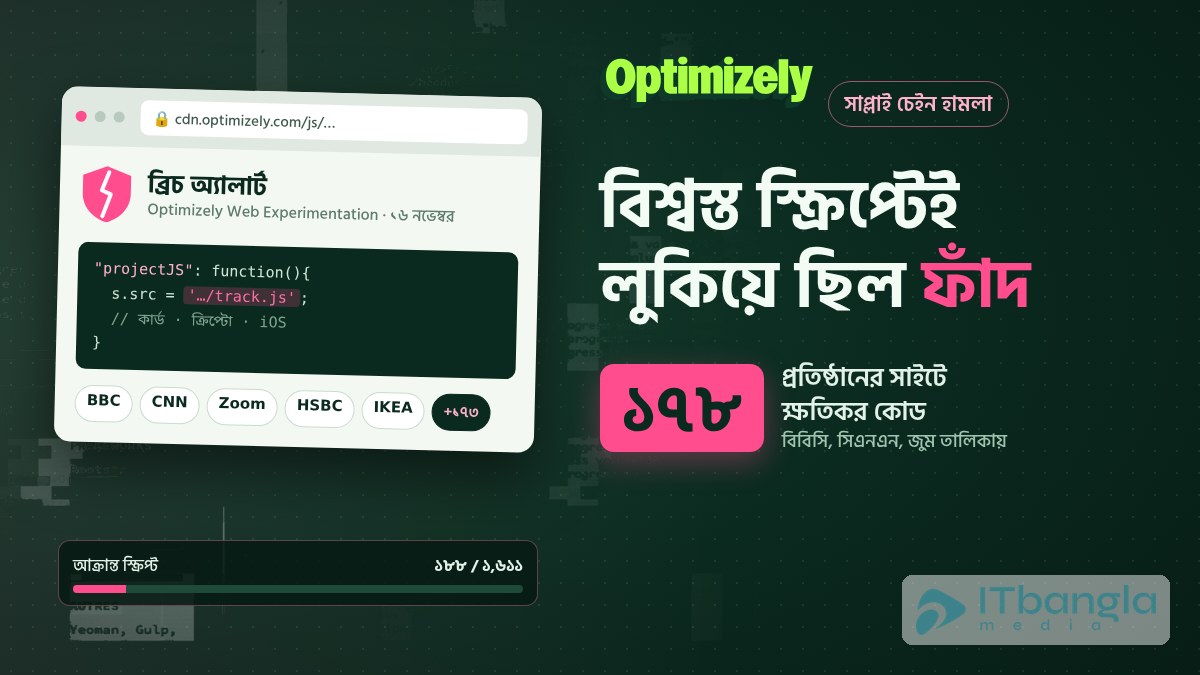
A hacker exploited a flaw in Optimizely, a popular website A/B-testing service, to push malicious JavaScript onto the websites of at least 178 organisations, including the BBC, CNN and Zoom. The code ran in visitors’ browsers throughout 16 November. It was built to steal cryptocurrency, capture payment card details and attack older iPhones and iPads.
The incident was first spotted by web security firm Report URI. In an analysis published on 16 November, Report URI security researcher Scott Helme said his team checked 1,611 Optimizely scripts (snippets) and found malicious code in 188 of them, belonging to 178 organisations. The team could only check the snippets it found in time, so he believes the real number is higher.
Besides the BBC, CNN and Zoom, Report URI’s list includes Salesforce, GitLab, IKEA, HSBC, Equifax, Air France-KLM, Ledger and Peacock. BleepingComputer used urlscan.io scans to confirm that the code loaded, or tried to load, on several sites including Zoom, KLM, GitLab, the BBC, CNN, Smartsheet and Salesforce. It said Fox News and UNICEF USA were also among the affected sites. By Report URI’s count, banks and financial firms were the largest group, with 32 organisations.
How the attack worked
Customers of Optimizely’s Web Experimentation service load a JavaScript file from Optimizely’s CDN on their sites. The file has a field called “Project JavaScript”, where customers can add their own code, and it runs on every page.
According to Report URI’s analysis, the attacker placed their code in exactly this field of customer projects and left the rest of the file untouched. The file was still delivered from Optimizely’s own domain, cdn.optimizely.com, with Optimizely’s SSL certificate, so neither the sites nor visitors’ browsers treated it as suspicious. The planted code pulled in the main malicious file, track.js, from an outside domain. The Hacker News reported that this domain was registered on the morning of the attack.
What it tried to steal
Analyses by BleepingComputer and Report URI found three main functions in track.js.
- Crypto address swapping: it replaced cryptocurrency wallet addresses found on the page, in forms or in the clipboard with the attacker’s own, so money sent to a copied address would go to the attacker.
- Card skimming: it captured card numbers, expiry dates and CVVs typed into a site’s own forms and sent them to an outside server. The Hacker News said it could not read card details entered in a payment provider’s separate frame, such as Stripe or Adyen.
- Attacks on iPhones and iPads: on Apple devices it tried to load two iOS exploit kits, Coruna and DarkSword, which target older iOS versions.
The code could also collect browser cookies, page addresses and screenshots. However, The Daily Star and The Hacker News, citing researchers, said there was no evidence so far that any physical iPhone or iPad had actually been compromised.
Report URI said crypto had already been stolen, with about $7,000 reaching the attacker’s wallets on 16 November. BleepingComputer noted that some of these wallets were active before the attack, so it is unclear how much came from visitors. Helme said there was no way to see how many card details were taken.
Timeline (Bangladesh time)
| Time | What happened |
|---|---|
| 16 Nov, 10:21 AM | Malicious code first seen in the BBC’s Optimizely script |
| 16 Nov, 7:43 PM | Card-skimming component added to the code |
| 17 Nov, around 2:40 AM | Mass removal of the code from affected scripts begins |
| 17 Nov, 3:52 AM | Code remains in only one of the 188 scripts |
| 17 Nov, 5:11 AM | All files monitored by Report URI found clean |
| 17 Nov, 7:02 AM | Optimizely confirms the incident on its status page |
Sources: Report URI, The Hacker News, Malwarebytes and Optimizely’s status page. Times were published in UTC and converted to Bangladesh time.
What Optimizely says
On its status page on 17 November, Optimizely said an unauthorised party exploited a vulnerability in its Experimentation service to add malicious JavaScript to some customer projects. It said the vulnerability had been fixed and the code removed from affected projects.
In a statement to BleepingComputer, the company said the vulnerability was in the Experimentation account signup flow. It said it had blocked access to the vulnerable path and deployed a fix, ended active sessions, revoked tokens and reset access for affected user accounts, and blocked such code from being delivered in Cloudflare. It said all affected customers had been notified and the investigation was continuing.
The Daily Star reported that an Optimizely employee confirmed the incident to it and that the company also posted a statement on LinkedIn. Optimizely has not said how many projects were tampered with. The Hacker News said its notice did not tell customers what to do.
Among the affected companies, Salesforce told BleepingComputer it had disabled Optimizely scripts across its sites as a precaution and would notify customers if it found unauthorised access to their data.
According to The Daily Star, Optimizely also disclosed a data breach in February this year, when attackers used social engineering to get into its internal systems.
Who is behind it
The attacker has not been publicly identified and no group has claimed responsibility. Some researchers call the campaign “OPTIMJACK”. Help Net Security reported that a crypto address used in the campaign also appeared in attacks in March and on 3 November, and that the same injection code first showed up on Turkish websites in September. Cybersecurity firm Hudson Rock and another researcher found the same code in scripts from Kissmetrics, StorifyMe and Minute Media, but they said this does not prove the same operator or the same entry point was behind them.
Most sites lacked adequate protection
Report URI checked the affected organisations’ sites and found that only 24 (15 percent) had a Content Security Policy (CSP) strict enough to block the attack. Sixty-eight had no CSP at all, and in 50 cases the policy let the code run and send stolen data out. “Trusted JavaScript doesn’t always remain trustworthy,” Helme said, adding that a website can be compromised through a third-party dependency without its own code or infrastructure ever being breached.
Citing website technology tracker BuiltWith, Malwarebytes said Optimizely is used on about 190,000 live websites. That is its overall usage, not the number of affected sites. No Bangladeshi organisation appears on Report URI’s published list of 178 organisations.
What researchers advise
Report URI and Malwarebytes advise visitors to:
- Update iPhones and iPads to the latest version. Report URI says at least iOS 18.7.3 or iOS 26.3 is needed.
- Check the recipient address of any crypto transaction made on 16 November.
- Watch card statements if they paid by card on an affected site that day, and contact their card issuer about anything suspicious.
Report URI advises organisations that use Optimizely to check the Project JavaScript of every project and the custom code of every experiment, review who can change code in their account and rotate passwords and API tokens, and deploy a strict CSP. Allowing only cdn.optimizely.com in a CSP does not help, it said, because the malicious code came from that domain.
Sources
- The Daily Star, ‘Optimizely cyberattack: BBC, CNN, and Zoom among 178 organisations affected’, 17 November 2026, updated 5:26 PM, https:/
/ www. thedailystar. net/ news/ technology/ news/ optimizely- cyberattack- bbc- cnn- and- zoom- among- 178- organisations- affected- 4326236 - Optimizely status page, ‘Web Experimentation Security Incident’, 17 November 2026, 7:02 AM (Bangladesh time), https:/
/ status. optimizely. com/ - Report URI blog, ‘World’s Largest Brands Infected With Malware Via Optimizely’, 16 November 2026, https:/
/ blog. report- uri. com/ worlds- largest- brands- infected- with- malware- via- optimizely/ - BleepingComputer, ‘Optimizely hack infected CNN, Fox News, BBC, Salesforce sites with malware’, 17 November 2026, 8:12 AM (Bangladesh time), https:/
/ www. bleepingcomputer. com/ news/ security/ optimizely- supply- chain- attack- infects- major- brands- sites- with- malware/ - Reuters (via Investing.com), ‘Popular websites subverted in bid to steal crypto, target iPhone users’, 16 November 2026, https:/
/ www. investing. com/ news/ stock- market- news/ popular- websites- subverted- in- bid- to- steal- crypto- target- iphone- users- 5031640 - The Hacker News, ‘Hijacked Optimizely Scripts Served Card Skimmer and iOS Exploit Kits to CNN, BBC and Zoom Visitors’, 17 November 2026, https:/
/ thehackernews. com/ 2026/ 11/ hijacked- optimizely- scripts- served- card. html - Help Net Security, ‘Malware spread through Optimizely hits 178 organizations, including BBC, CNN and Zoom’, 17 November 2026, https:/
/ www. helpnetsecurity. com/ 2026/ 11/ 17/ optimizely- vulnerability- malicious- javascript/ - Malwarebytes blog, ‘CNN, BBC, Zoom, and other sites served malicious code in supply-chain attack’, 17 November 2026, https:/
/ www. malwarebytes. com/ blog/ news/ 2026/ 11/ cnn- bbc- zoom- and- other- sites- served- malicious- code- in- supply- chain- attack