
Public comments sought on Cyber Security Act amendment proposals, deadline 25 November
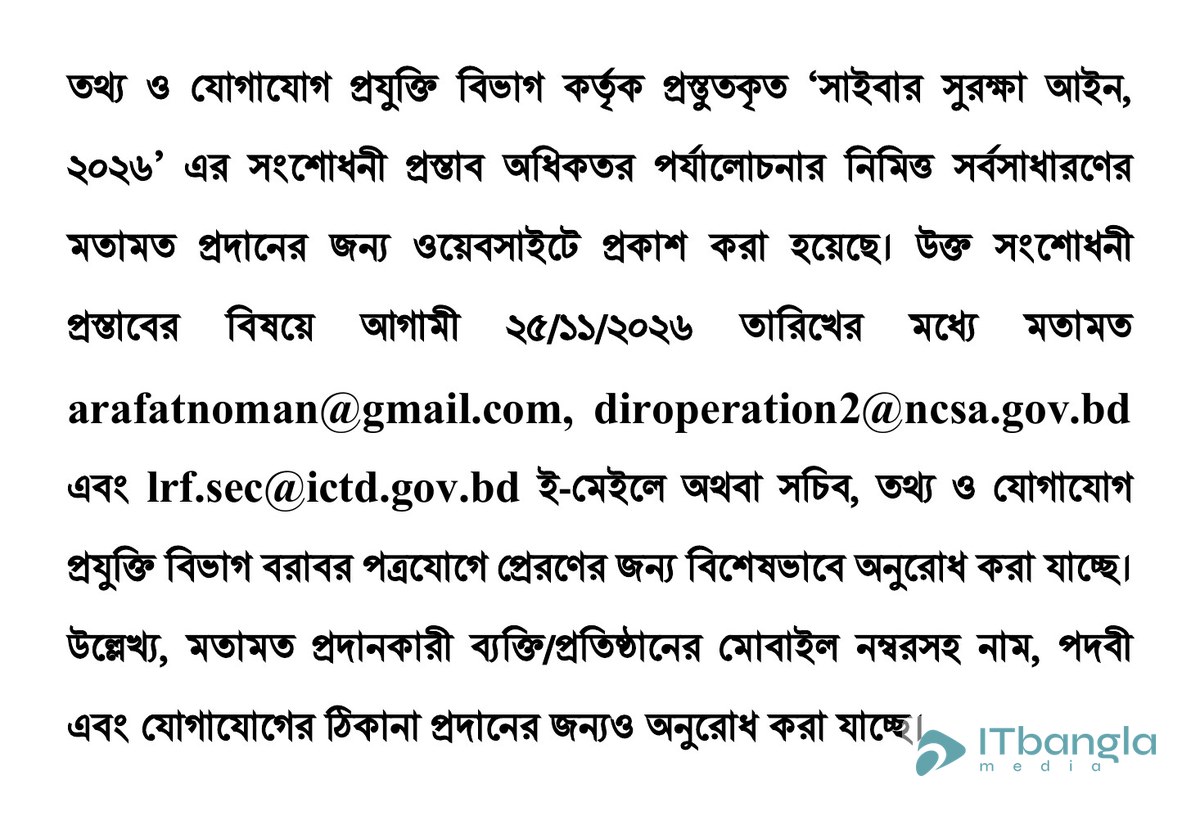
The ICT Division has invited public comments until 25 November on proposed amendments to the Cyber Security Act, 2026. A comparative statement sets out new offences, penalties and content-removal provisions.

Our correspondent
The Information and Communication Technology Division has invited public comments on proposed amendments to the Cyber Security Act, 2026, for further review. According to the Division’s notice, comments must be submitted by 25 November 2026. The notice was published on the Division’s website on 10 November. In the accompanying comparative statement, the proposal is presented as the Cyber Security (Amendment) Act, 2027.

The notice asks that comments on the amendment proposals be sent by 25 November to three email addresses: [email protected], [email protected] and [email protected]. Comments may also be sent by letter to the Secretary, Information and Communication Technology Division. Individuals and organisations submitting comments are asked to include their name, designation, contact address and mobile number.
The Division’s publicity graphic also gives the deadline as 25 November 2026 and lists the email address [email protected]. The website lists an archive date of 19 November 2026 for the notice; the notice itself and the graphic, however, state that comments are due by 25 November. The page was last updated at 12:27 p.m. (Asia/Dhaka) on Wednesday, 11 November.
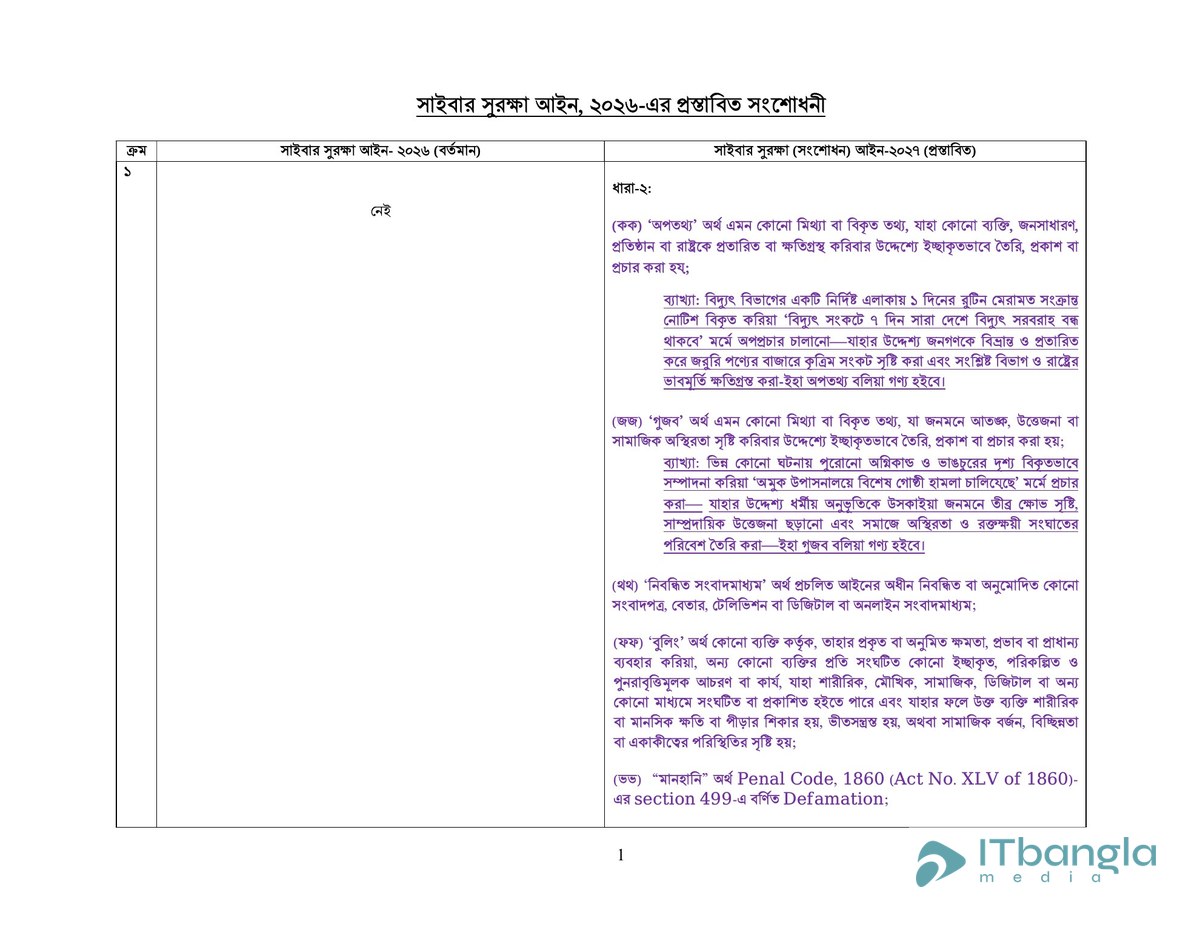
Four documents are attached to the notice: the notice as published on the website; a comparative statement of the proposed amendments to the Cyber Security Act, 2026; the already enacted Cyber Security (Amendment) Act, 2026; and the principal Cyber Security Act, 2026. The comparative statement sets out 19 items, with the current law and the proposed wording side by side. Its title indicates it is a 9 November draft prepared without earlier comments incorporated.
How the Act came into force
The Cyber Security Act, 2026 is Act No. 81 of 2026, published in an extra issue of the Bangladesh Gazette on Friday, 10 April 2026. The Act, as passed by Parliament, received the President’s assent on 27 Chaitra 1432, corresponding to 10 April 2026. According to the Gazette, it was enacted to repeal the Cyber Security Ordinance, 2025 (Ordinance No. 25 of 2025) and to provide for ensuring cyber security and for the identification, prevention, suppression and trial of offences committed in cyberspace. The Gazette states that the Act is deemed to have come into force on 21 May 2025.
An extra Gazette dated Wednesday, 1 July 2026 then published Act No. 99 of 2026, the Cyber Security (Amendment) Act, 2026. That amendment repealed Section 20 of the principal Act and stated that it would come into force at once. The comparative statement attached to the new notice is not that July amendment; it is a later draft of a proposed Cyber Security (Amendment) Act, 2027.
What the proposals say
According to the comparative statement, several new definitions would be added to Section 2. These include “disinformation” (অপতথ্য), “rumour” (গুজব), “registered media”, “bullying”, “defamation” and “humiliation” (হেয়প্রতিপন্ন). The definitions of disinformation and rumour are accompanied by explanatory examples. Defamation is to be read as defamation described in section 499 of the Penal Code, 1860. The definition of “cyberspace” in Section 2 would also be expanded with examples such as websites and programming.
The heading of Section 3 would change from “application of the Ordinance” to “application of the Act”. Sub-section (1) would be shortened to provide that, in the event of inconsistency with any provision of any other law, the provision of this Act would prevail. The existing exception — that the Right to Information Act, 2009 would continue to apply in matters relating to the right to information — would be retained.
Section 8(2) would widen both who may request the removal or blocking of content and on what grounds. The power currently rests mainly with law-enforcement agencies. Under the proposal, the Ministry of Information and Broadcasting, or any agency, institution or force empowered by the government for this purpose, could also make such a request. The grounds would be set out in separate clauses covering, among other things, harm to the country’s integrity, dignity, security, defence or public order; incitement of religious or communal hatred or ethnic violence; directions to cause disorder or criminal activity; and blackmail, sexual harassment, revenge porn, child sexual abuse material, sextortion, defamation, humiliation or bullying.
Section 8(3) would also allow removal or blocking when an order of the Tribunal is received. A new proviso would require that, if information or data is removed or blocked, the person or institution concerned must, where applicable, be told the reason within three days.
Section 8(4) would change the route for review or restoration. Under the current provision, Cyber Tribunal approval must be obtained within three days of a removal, transfer or block; if approval is not obtained in time, or if the Tribunal so directs, the information or data must be restored. Under the proposal, an aggrieved person could apply to the relevant agency for restoration, and the application would have to be disposed of within 15 days after giving the applicant and the government or the other party concerned a hearing. “Aggrieved person” would mean the person or institution against whom the action was taken, as well as a legal representative, guardian, family member or any other person with a lawful interest.
Section 12 would reorganise the membership of the National Cyber Security Council. The comparative statement shows the Minister for Foreign Affairs, the Minister for Information and Broadcasting and the Cabinet Secretary being added to the Council. Section 14 would change the regular meeting interval from at least once every three months to at least once every six months, while still allowing meetings to be called in an emergency.
New offences and penalties
Section 25, which deals with sexual harassment, blackmail or the publication of obscene material, would carry higher maximum penalties. The current maxima are two years’ imprisonment or a fine of Tk 10 lakh, or both, in ordinary cases, and five years or Tk 20 lakh, or both, where the offence is against a woman or a child under 18. The proposal would raise those maxima to five years or Tk 20 lakh, or both, and, for offences against a woman or a child, 10 years or Tk 40 lakh, or both.
Two new sections are proposed. Section 25A would make defamation using cyberspace an offence, punishable by up to two years’ imprisonment or a fine of Tk 5 lakh, or both. Section 25B would make it an offence to humiliate or bully a person using cyberspace, punishable by up to three years’ imprisonment or a fine of Tk 5 lakh, or both.
For Section 26, which covers the publication of material inciting religious or ethnic violence, hatred or hostility, the maximum term of imprisonment would rise from two years to five years; the maximum fine would remain Tk 10 lakh. A new Section 26A would make the circulation of rumours and disinformation in cyberspace an offence, punishable by up to five years’ imprisonment or a fine of Tk 10 lakh, or both.
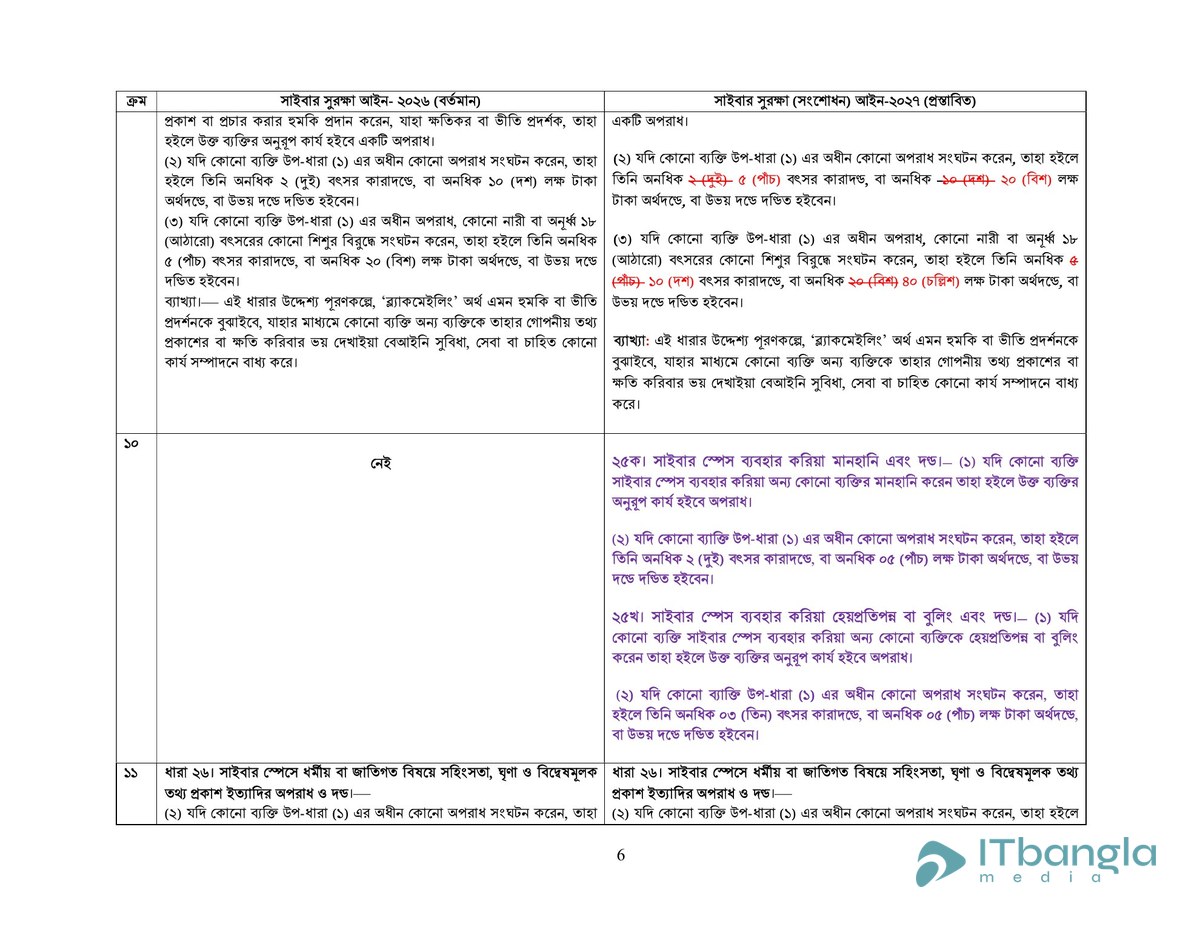
| Section | Subject | Proposed maximum penalty |
|---|---|---|
| 25 | Sexual harassment, blackmail or obscene material | 5 years or Tk 20 lakh, or both; 10 years or Tk 40 lakh, or both, where the victim is a woman or a child |
| 25A (new) | Defamation in cyberspace | 2 years or Tk 5 lakh, or both |
| 25B (new) | Humiliation or bullying | 3 years or Tk 5 lakh, or both |
| 26 | Religious or ethnic violence, hatred or hostile material | 5 years or Tk 10 lakh, or both |
| 26A (new) | Circulation of rumours and disinformation | 5 years or Tk 10 lakh, or both |
Section 46, which classifies offences as cognizable or non-cognizable, bailable or non-bailable, and compoundable or not, would be updated to take account of the new sections. According to the comparative statement, Sections 25B, 26 and 26A would be cognizable and non-bailable, while the new Section 25A would be bailable and is not listed among the cognizable offences. The proposal would also remove Section 25 from the list of offences that may be compounded with the court’s consent.
The media, companies and immunity
A new Section 46A would require prior permission of the Tribunal before anyone is arrested in connection with news, opinion, an image or a cartoon published or broadcast in a registered media outlet under this Act.
Section 29 would change how offences by companies are defined and what consequences may follow. “Company” would include a company formed and registered under the Companies Act, 1994, as well as a commercial institution, partnership, association or unregistered body. A new sub-section (3) would allow a court, on conviction, to suspend, cancel or prohibit the company’s registration, licence or operations. In the case of a registered media outlet or an organisation that operates a media outlet, a written notice of at least 15 days and a reasonable opportunity of being heard would be required before such a measure was taken.
Section 41 would set time limits for appeals. An appeal to the Cyber Appeal Tribunal would have to be filed within 60 days of the Tribunal’s judgment or order, and the appeal would have to be disposed of within 90 days of the date of notice of the filing. Section 49, on the power to make rules, would be expanded to cover time limits for the removal or blocking of online content and the procedure for dealing with technology companies.
A new Section 52 would add an immunity clause. The chair and members of the National Cyber Security Council, and every officer or employee empowered under the Act, would be deemed public servants within the meaning of section 21 of the Penal Code. The proposal also states that no civil or criminal case could be filed against them for anything done in good faith under the Act.
The changes described in this report remain draft proposals; they are not yet law passed by Parliament. The deadline for comments is 25 November 2026.
The notice’s publicity graphic was shared on Thursday, 12 November at 4:49 p.m. (Asia/Dhaka) on the Facebook profile of AHM Bazlur Rahman, chief executive of the Bangladesh NGOs Network for Radio and Communication (BNNRC).
Sources
- Information and Communication Technology Division, notice: invitation of public comments on the proposed amendments to the Cyber Security Act, 2026, for further review. Date of publication: 10 November 2026. Page last updated: Wednesday, 11 November 2026, 12:27 p.m. (Asia/Dhaka). https://ictd.gov.bd/
pages/ notices/ সাইবার-সুরক্ষা-আইন-২০২৬-এর-সংশোধনী-প্রস্তাব-অধিকতর-পর্যালোচনার-নিমিত্ত-সর্বসাধারণের-মতামত-প্রদান-সংক্রান্ত- a1dqdx- 6af2efde862c6f28f3cb3a38 - Information and Communication Technology Division, attached documents: the notice as published on the website; comparative statement of the proposed amendments to the Cyber Security Act, 2026; the Cyber Security (Amendment) Act, 2026; and the Cyber Security Act, 2026. Available for download from the notice page above.
- Facebook post by AHM Bazlur Rahman, Thursday, 12 November 2026, 4:49 p.m. (Asia/Dhaka). https://www.facebook.com/
100000277158936/ posts/ 29815456651380180/