
APNIC at bdNOG22: deploy IPv6, RPKI and ROV to strengthen Bangladesh’s Internet
At bdNOG22 in Cox's Bazar, APNIC Director General Jia Rong Low stressed IPv6, RPKI and ROV deployment and community participation in policy development, while sessions covered ASPA, ROAs and peering and transit under the new telecom policy.

Staff Correspondent
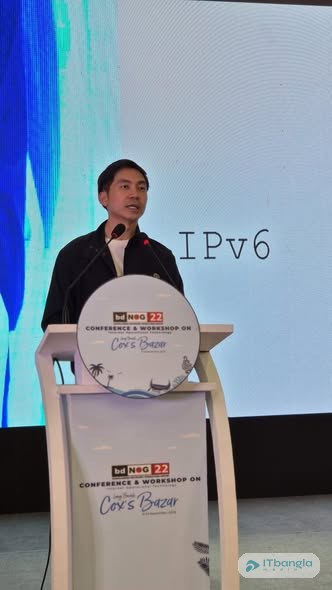
At the just-concluded 22nd conference of the Bangladesh Network Operators Group (bdNOG) in Cox’s Bazar, APNIC, the regional Internet address registry for the Asia Pacific, stressed deploying IPv6, RPKI and ROV to strengthen Bangladesh’s Internet. APNIC Director General Jia Rong Low said these technologies, together with the local network community’s participation in APNIC’s policy development process, can help make the country’s Internet stronger for the future.
APNIC shared this summary of its representatives’ talks in a post on its Facebook page at 7:57am on Monday. The post also congratulated the organisers on a successful event.
According to the bdNOG website, the workshops ran from 11 to 13 November and the main conference took place on 14 November at the Long Beach Hotel, Cox’s Bazar. itbangla earlier covered the workshops and the conference schedule and the information security workshop.
The Director General’s message
Jia Rong Low’s keynote at the closing plenary was titled “From growth to resilience: Strengthening Bangladesh’s Internet for the next decade”. According to APNIC’s post, he highlighted deploying IPv6, RPKI and ROV, as well as community participation in APNIC policy development.
According to APNIC’s website, Jia Rong Low became Director General in October 2024. He previously served as Managing Director of ICANN’s Asia Pacific regional office.
ASPA and ROA for routing security
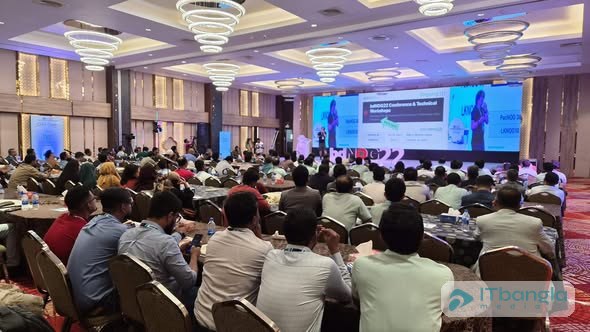
The post said APNIC’s Md. Abdul Awal explored how ASPA can help network operators strengthen routing security; his session was listed as “BGP Path Validation with ASPA”. APNIC Executive Council (EC) member Yoshinobu Matsuzaki discussed using ROAs to protect against unauthorised route announcements, in a session listed as “One ROA against unauthorized announcements” under Japan’s IIJ.
Peering and transit under the new telecom policy
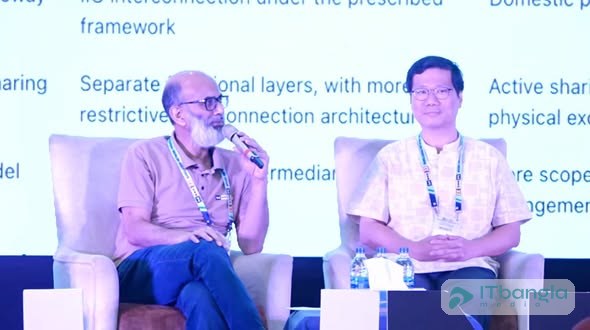
APNIC EC members Sumon Ahmed Sabir and Kam Sze Yeung joined a panel on peering and transit models under Bangladesh’s new telecom policy. According to the bdNOG schedule, the “Panel Discussion on Exploring the Best Peering and Transit Model Under New Telecom Policy” also listed Moin Uddin Ahmed, Brig. Gen. Shafiul Azam Parvez, Director General of BTRC’s Engineering and Operations Division, and Tashi Phuntsho. APNIC’s post did not say what the panellists said.
The government approved the Telecommunications Network and Licensing Policy 2025 on 4 September last year. According to The Business Standard’s report that day, international connectivity services covering voice, data, internet and peering will be handled by International Connectivity Service Providers, Access Network Service Providers must interconnect voice and data locally, and National Internet Exchange (NIX) licences will be scrapped, though peering arrangements will continue.
What these technologies are
- IPv6: the newer version of Internet addressing. As IPv4 addresses run out, ISPs often share one address among many customers (CGNAT). IPv6 has no such shortage, which makes it easier to grow networks.
- RPKI: a certificate-based system that lets holders cryptographically prove which IP address blocks belong to them. Regional registries such as APNIC issue these certificates.
- ROA: a signed record in RPKI in which the address holder states which Autonomous System (AS) may announce its IP block on the Internet.
- ROV: the process of routers checking announcements against ROAs. If an announcement does not match, for example when someone announces another network’s IP block as their own, networks running ROV can drop it.
- ASPA: a newer RPKI-based mechanism in which a network declares its upstream providers. This allows the whole BGP path to be checked, making route leaks and forged paths easier to detect. While a ROA validates only a route’s origin, ASPA also validates the path.
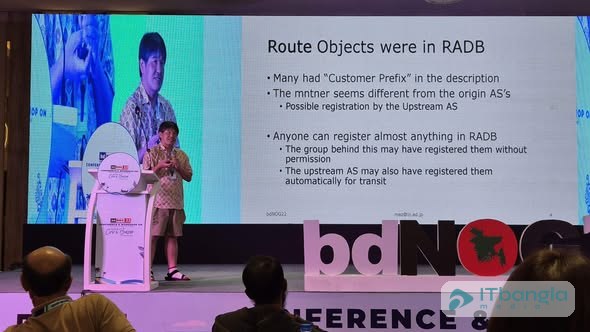
For Bangladeshi ISPs this matters directly. If someone announces an organisation’s IP block, by mistake or on purpose, traffic can be sent the wrong way and customer service disrupted. Creating ROAs for their own address blocks and enabling ROV on routers reduces that risk. One slide at the conference also showed a path hijack example that exploited a missing ROA.
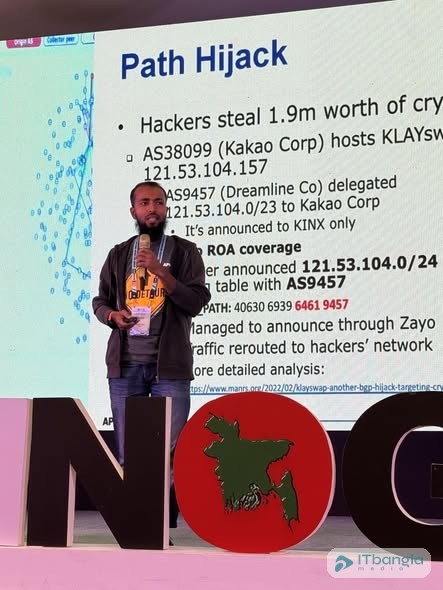
Besides APNIC, the conference schedule included speakers from Team Cymru, TWNIC, BTCL, Flexoptics and others. APNIC was one of the event’s gold sponsors.
Sources
- APNIC Facebook post, 16 November 2026, 7:57am (Asia/Dhaka), https://
www. facebook. com/ story. php? story_fbid= 1577937761033694& id= 100064524556552 - bdNOG: bdNOG22 Conference & Technical Workshops (viewed 16 November 2026), https://
www. bdnog. org/ conferences/ bdnog22 - bdNOG: bdNOG22 Event Sponsors, https://
www. bdnog. org/ conferences/ bdnog22/ sponsors - APNIC: Jia Rong Low, Director General, https://
www. apnic. net/ about-apnic/ team/ jia-rong-low/ - APNIC Blog: APNIC appoints Jia Rong Low as Director General, 30 July 2024, https://
blog. apnic. net/ 2024/ 07/ 30/ apnic-appoints-jia-rong-low-as-director-general/ - APNIC: APNIC Executive Council, https://
www. apnic. net/ about-apnic/ organization/ structure/ apnic-executive-council/ - The Business Standard: Govt approves new telecom policy, operators optimistic, international gateways fear losing ground, 4 September 2025, 10:20pm, https://
www. tbsnews. net/ bangladesh/ telecom/ govt-approves-new-telecom-policy-operators-optimistic-international-gateways-fear - itbangla: bdNOG22 workshops end, main conference today at Long Beach Hotel, 14 November 2026, https://
itbangla. media/ en/ tech/ telecom-internet/ i6mfsvnmmb/