


UddoktaPay says Databasify, an open-source self-hosted database platform, is now in beta
UddoktaPay says Databasify, an open-source platform for running PostgreSQL, MySQL, MariaDB, MongoDB, Valkey and Redis on your own servers, is now in beta.
Bangladeshi payment-gateway company UddoktaPay said on Thursday, 12 November 2026, at 12:07 p.m. (Asia/Dhaka) that Databasify, an open-source, self-hosted DBaaS platform, is now in beta. The post on its verified Facebook page presents the project as an alternative to DigitalOcean Managed Databases, Amazon RDS and Aiven, and says PostgreSQL, MySQL, MariaDB, MongoDB, Valkey and Redis can be run on servers you own. The repository link was posted in the comments.
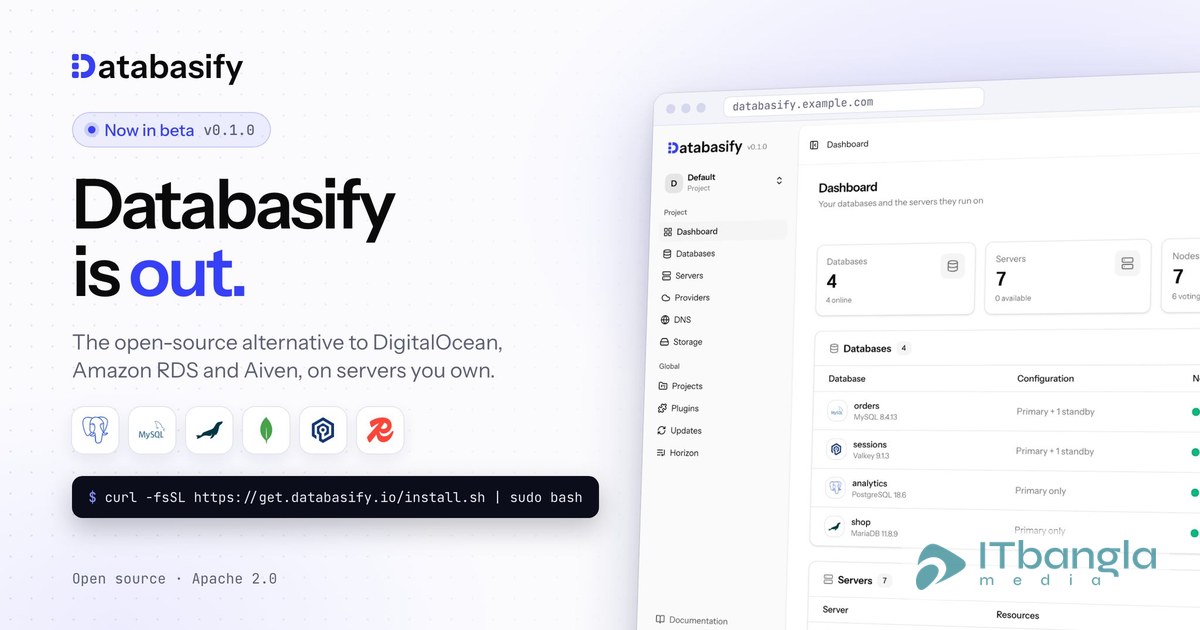
The project is published on GitHub by the Databasify Labs organisation. The repository description and the official site, databasify.io, make the same claim: it is a platform for creating and running databases on your own servers, from a single node to a high-availability cluster with automatic failover. The software is open source under the Apache License 2.0. Documentation is at docs.databasify.io. The codebase is written in Laravel and PHP, with a React interface.
The first public release, 0.1.0, was published today, 12 November 2026, at 10:18 a.m. (Asia/Dhaka). UddoktaPay’s post and promotional graphic call it a beta. The GitHub release itself is not marked as a pre-release. The repository was created on 6 November 2026 at 11:53 a.m. (Asia/Dhaka), and the first commit was made at the same time. When this report was prepared (12 November 2026, 12:50 p.m., Asia/Dhaka), the repository had 6 stars, 2 forks and 127 commits. Apart from bots, there was one contributor: Rasel Islam Rafi (GitHub: rtraselbd).

The announcement came from UddoktaPay’s official Facebook page. The software is published under the Databasify Labs name on GitHub. Commits in the repository and the 0.1.0 release are authored by Rasel Islam Rafi. His GitHub profile lists UddoktaPay as his company, and on his own website he describes himself as the creator of UddoktaPay. The public member list of the Databasify Labs organisation is empty, so a fuller ownership or team structure could not be confirmed from these sources.
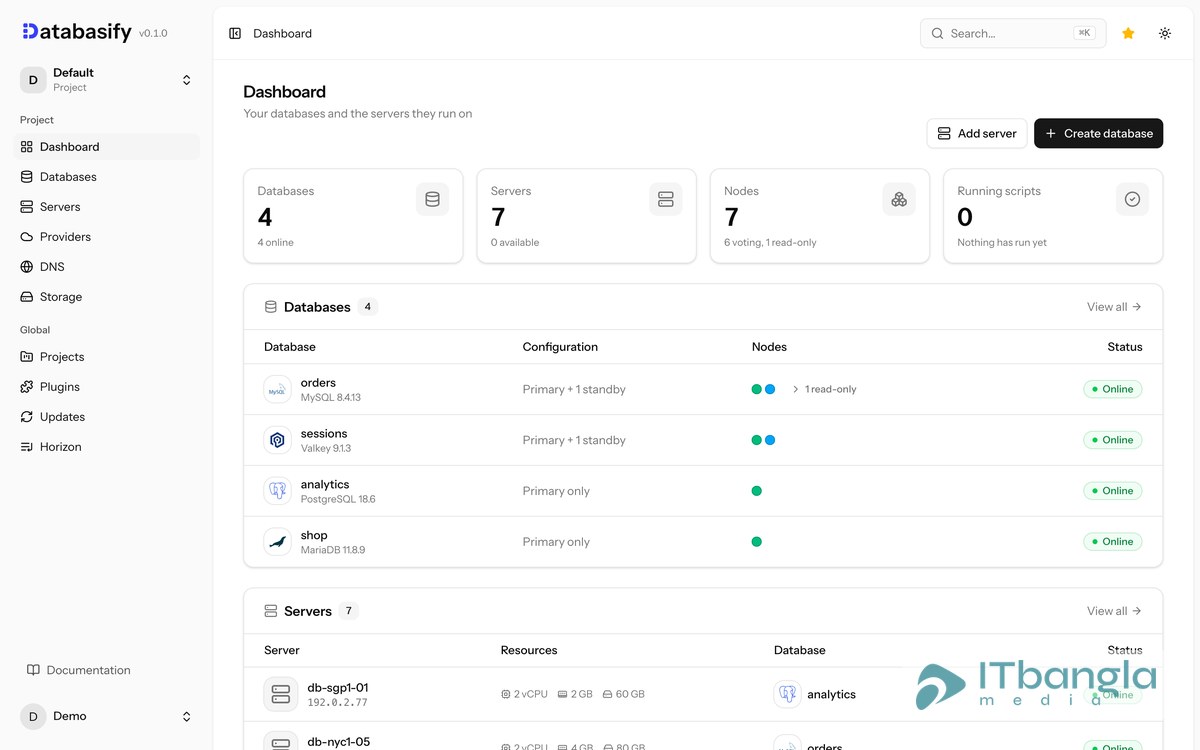
Supported databases
According to the repository, the 0.1.0 release notes and the documentation, these engines and versions are listed:
| Engine | Versions listed in the docs |
|---|---|
| PostgreSQL | 15, 16, 17 and 18 |
| MySQL | 8.4 and 9.7 |
| MariaDB | 10.11, 11.4, 11.8 and 12.3 |
| MongoDB | 7.0, 8.0 and 9.0 |
| Valkey | 7, 8 and 9 |
| Redis | 7.2 and 8 |
The README says each engine lives in its own repository and is built on a public engine SDK. It also says plugins can add more DNS providers, server providers or community database engines.
Features described in the documentation
According to the README, the release notes and the official documentation, the platform currently describes these features:
- A single primary, or a cluster with up to two standbys and read-only nodes, plus automatic failover. The documentation says automatic failover needs three voting nodes, and that failover keeps working while the Databasify app is down.
- Engine-specific high-availability tooling: Patroni and etcd for PostgreSQL, InnoDB Cluster for MySQL, Galera for MariaDB, a replica set for MongoDB, and Sentinel for Valkey and Redis.
- Point-in-time backups and restores to S3-compatible storage. The site states that this is not available for MongoDB 9.0, Valkey or Redis.
- TLS on every connection, hostnames on your own domain (through Cloudflare DNS), user and schema management, PostgreSQL connection pools, metrics, logs and email alerts.
- Migrations from an existing database — a one-time copy, or continuous sync until cutover.
- Automatic patch updates in a weekly maintenance window, project-based grouping, plugins, two-factor authentication and passkeys. The release notes also mention a browser terminal for each database.
The same documentation includes a caution: PostgreSQL, Valkey and Redis replicate asynchronously, so a failover can lose the last writes.
Installation and requirements
According to the repository and the documentation, it can be installed on a Linux server with at least 1 GB of memory (2 GB recommended) with this command:
curl -fsSL https://get.databasify.io/install.sh | sudo bash
Supported operating systems are Ubuntu 24.04 and 26.04, Debian 12 and 13, Rocky Linux 9 and AlmaLinux 9. The documentation says the installer stops on any other system before it changes anything. The Databasify server needs root access and a free port 80, or another port set with HTTP_PORT. The installer installs Docker if it is missing. The docs also warn that a 1 GB server may use swap when busy.
Database nodes run on separate servers; a server runs at most one node. Servers can be added over SSH, or created on DigitalOcean, Hetzner, Vultr or Linode. At least 1 GB of memory is recommended for each node, but no minimum is enforced. Standby and read-only nodes must share a private network with the primary; if they do not, Databasify can create an encrypted WireGuard network, the documentation says.
What this can mean for users in Bangladesh
Managed services such as Amazon RDS, DigitalOcean Managed Databases or Aiven add a management fee on top of server costs, usually billed in foreign currency. Databasify’s website says the software itself is free to use, and that you pay only for your own servers. For Bangladeshi developers and hosting users, that can mean running databases on a local or BDIX-connected VPS, keeping data under their own control and reducing latency to their apps. This report does not compare prices, because costs vary with the type, location and use of the servers.
The project is new, and UddoktaPay itself describes it as a beta. Backups, failover behaviour and security limits should be checked before any production use. According to SECURITY.md, every signed-in user on an instance can manage all of that instance’s servers and databases.
Sources
- UddoktaPay Facebook page post, 12 November 2026, 12:07 p.m. (Asia/Dhaka), https://www.facebook.com/
uddoktapay/ posts/ pfbid02gX KFQeyEEca 5hApx1gFY oCeA39h4G cDgWEAh4N ZiemAbCxL 9HSLhkqzi KMMhSQC2l - Databasify Labs, GitHub repository databasifylabs/databasify, https://github.com/
databasifylabs/ databasify - Databasify 0.1.0 release, 12 November 2026, 10:18 a.m. (Asia/Dhaka), https://github.com/
databasifylabs/ databasify/ releases/ tag/ 0.1.0 - Databasify website, https://databasify.io, and documentation, https://docs.databasify.io











Comments