


ZynoHost introduces email-based two-factor authentication for client accounts
ZynoHost customers can now require a six-digit code sent by email, in addition to their password, to log in to the Client Area. Each code is valid for 10 minutes.
Staff Correspondent
Bangladeshi web hosting company ZynoHost has introduced email-based Two-Factor Authentication (2FA) for customer accounts. Once enabled, logging in to the Client Area will require a six-digit code sent by email in addition to the password. The company announced the feature in a post on its verified Facebook page at 2:54pm on Sunday (15 November).
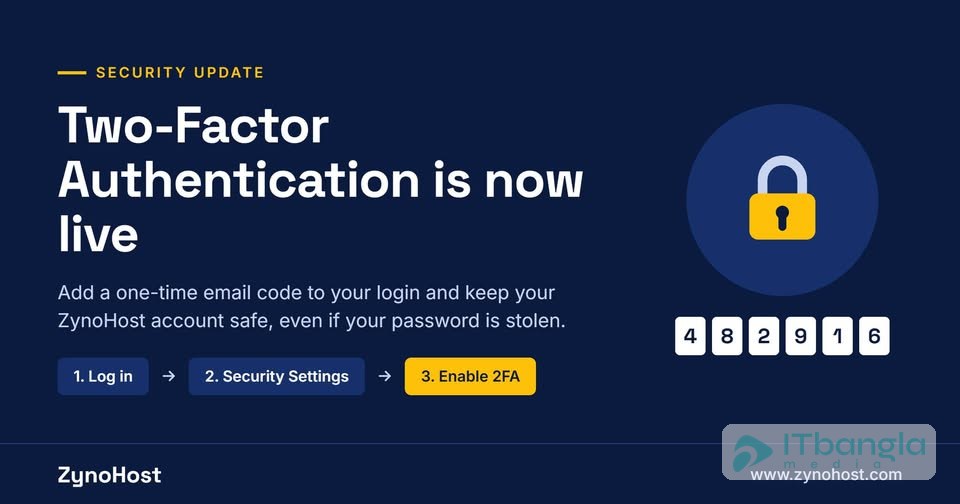
According to the post, the feature is now available for all ZynoHost accounts. It is not switched on automatically; customers have to enable it from their Security Settings.
How to turn it on
ZynoHost’s post lists these steps:
- Log in to your account at billing.zynohost.com.
- Open Security Settings from the menu under your name.
- Click Enable Two-Factor Authentication and choose Email Code.
- Enter the six-digit code sent to your email and click Verify and enable.
The company said each code is valid for 10 minutes and can be used only once. Users can also choose to skip the code for up to 30 days when signing in again from the same IP address. The post warned that ZynoHost staff will never ask for the code, so it should not be shared with anyone. The company says the setup takes less than a minute and adds protection to customers’ services, domains and billing details.
Why hosting accounts need the extra step
A hosting provider’s Client Area is usually where customers manage their hosting services, domain nameservers and DNS, payments and support tickets. If only a password stands in the way, anyone who obtains it could move a domain elsewhere or change its nameservers to redirect a website and its email. This is known as domain hijacking.
In a 2009 report (SAC040), the Security and Stability Advisory Committee (SSAC) of ICANN, the body that coordinates the internet’s domain name system, said a second factor makes it harder to break into a domain account, because an attacker who has the password still lacks the second factor. The report also listed requiring multi-factor authentication for DNS configuration changes as an important safeguard. The US Cybersecurity and Infrastructure Security Agency (CISA) said in a 2022 fact sheet that any form of multi-factor authentication (MFA) is better than none.
The limits of email codes
Not all 2FA methods are equally strong, however. The latest version of the US National Institute of Standards and Technology’s (NIST) digital identity guideline, SP 800-63B, says email shall not be used for out-of-band authentication. It gives three reasons: many email accounts can be accessed with just a password, messages can be intercepted in transit or at intermediate mail servers, and email can be rerouted through attacks such as DNS spoofing.
For users, this means that with email codes, the security of the hosting account depends largely on how well the email account is protected. If the hosting account and the mailbox share a password, or the mailbox has no 2FA of its own, much of the benefit of the extra step is lost. CISA describes phishing-resistant MFA, such as FIDO or WebAuthn-based security keys and passkeys, as the most secure form. ZynoHost’s post mentions only email codes; it does not say whether authenticator-app or passkey options are available.
The option to skip the code for 30 days from the same IP adds convenience, since users who log in regularly from one place do not have to enter a code every time. It also carries some risk. In offices and on some internet connections, many people share one public IP address, so someone else on that network who knows the password could log in without a code. It is safer not to choose this option on shared computers or public networks. The choice is left entirely to the customer.
About ZynoHost
ZynoHost’s website says the company started in 2025. According to the site, it offers shared, BDIX and reseller hosting, VPS, dedicated servers and domain registration. The site footer describes ZynoHost as a Nexelogy service and lists addresses for Nexelogy Ltd. in Sutrapur, Dhaka, and Nexelogy LLC in Wyoming, USA.
Sources
- ZynoHost’s verified Facebook page post, 15 November 2026, 2:54pm (Asia/Dhaka): facebook.com/
story.php? story_fbid= 122193767288740534 &id= 61572216032213 - ZynoHost, About Us (accessed 16 November 2026): zynohost.com/
about-us.php - NIST, SP 800-63B-4 ‘Digital Identity Guidelines: Authentication and Authenticator Management’, section 3.1.3: pages.nist.gov/
800-63-4/ sp800-63b.html - CISA, ‘Implementing Phishing-Resistant MFA’, October 2022: cisa.gov/
sites/ default/ files/ publications/ fact-sheet-implementing- phishing-resistant-mfa-508c.pdf - ICANN SSAC, SAC040 ‘Measures to Protect Domain Registration Services Against Exploitation or Misuse’, 19 August 2009: icann.org/
en/ system/ files/ files/ sac-040-en.pdf









Comments